
Article
Airbrush Air Caps Explained : Differences, Purposes, Pros & Cons. Which is the right one for you.
Understand airbrush air caps: crown, fan, and round caps. Learn their pros, cons, and purposes to choose the right air cap for your painting.
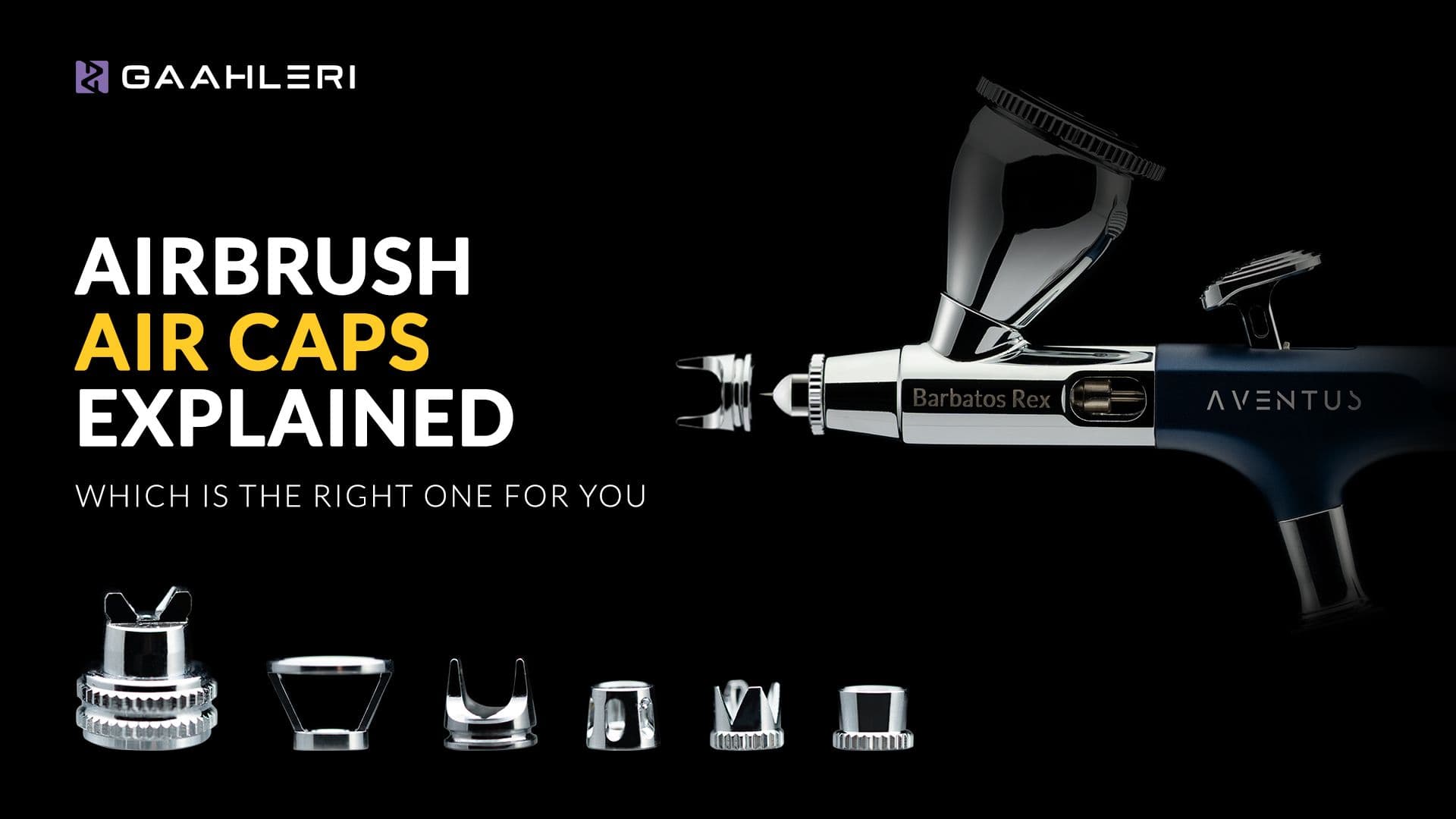
In the community, we’ve noticed that a lot of painters choose different air caps for different jobs , but some folks aren’t totally sure what each type actually does or when to use them. So let’s break it down.
Air caps are one of those simple parts that are often taken for granted, but they affect and shapes the airflow, atomization, and how paint comes out of your airbrush. They also help protect the needle, which is one of the most delicate parts of the tool.
In this article, we'll talk about purposes of air caps, and their respective advantages and disadvantages.
Round Wide Cap and Round Pattern Air Cap

The Round Wide Cap and Round Pattern Air Cap are the classic air caps suitable for most spraying tasks, produces a symmetrical round pattern. The angle of these caps aligns with the paint mist, so when spraying large areas, they can effectively reduce the accumulation of paint on the cap and minimize paint splattering. These caps maintain a solid atomization area while expanding the diffusion area, making them suitable for shading and creating blurred edges.
Pros:
Balanced and versatile spray pattern
Easy to control
Suitable for both detail and coverage
Stable and predictable performance
Cons:
Moderate overspray compared to narrower designs
Use case:
General-purpose spraying. The all-round standard, detail and covering medium areas, reliable, versatile, and suitable for most general airbrushing applications.
Round-Narrow Pattern with Contraction-Type


The Crown Pattern Air Cap is a specialized air cap with a unique crown-shaped design, featuring notches or cutouts around the edges. The crown shape with cutouts helps reduce paint build-up at the nozzle tip. By allowing air to escape through the notches, it prevents the accumulation of paint that can cause clogging or uneven spray patterns, making it ideal for longer airbrush sessions. The notches in the crown cap allow additional airflow around the nozzle, enhancing the atomization process. This creates a finer spray with smoother transitions, which is especially useful for creating soft shading and smooth gradients. The crown cap design enables the user to work closer to the surface without risking paint pooling or splattering. The unique crown pattern disperses the air and paint flow in a way that softens the edges of the spray pattern
Pros:
Allows extremely close spraying
Reduces paint buildup
Improves visibility and control of the needle tip
Offers a more diffused atomization compared to the standard round pattern air cap.
Softens Spray Edges
Cons:
Less protection for the needle
Does not significantly alter spray pattern
Requires careful handling
Requires a rubber cap to block the tip while blackflushing during cleaning.
Use Case: Close up work on detailed, intricate and precision task, such as highlights, sharp lines, or fine details in illustrations or model painting. Creating smooth transitions, gradients, soft shading and subtle blending effects, giving a more natural and refined finish.
Fine Line Air Cap

The Fine Line Air Cap avoids the issue of paint accumulation inside traditional air caps while retaining some needle protection. When using the Fine Line Air Cap, you can use a ruler to help create straight lines, and if paint builds up on the needle tip, you can easily clean it with your finger, which is very convenient. It can also be applied directly to the object being sprayed (especially on paper surfaces), spraying uniform lines without causing vacuum suction. However, the Fine Line Air Cap does not fully cover the needle, which may leave it vulnerable to side impacts and potential damage.
Pros
Extremely tight and precise spray pattern
Excellent for micro-detailing and fine lines
Allows extremely close spraying
Minimal overspray
Improves visibility and control of the needle tip
Cons
Lower paint output (slower coverage)
Requires careful handling, as risk of needle damage is significantly increased
Requires higher control and experience
Use Case: Maximum precision control. Ultra-fine lines and and high-accuracy applications; model detailing, micro-shading.
Distance Air Cap

Pros:
Preventing paint accumulation like the Fine Line Air Cap
Allows close range straight line spraying using a ruler
Can be placed directly against the surface (especially on paper) to spray consistent-width lines without causing vacuum suction.
Achieving effects similar to not using an air cap
Accomodates the requirements of large are atomization
Provides comprehensive protection for the needle tip
Prevents Overspray
Cons:
Requires a rubber cap to block the tip or even removing the air cap while blackflushing during cleaning.
Unable to go closer compare to the fine line air cap.
Use Case:
Placed directly against the surface (especially on paper) to spray consistent-width lines without causing vacuum suction, beginner friendly when drawing lines as it provides a fixed distanced without damaging the needle tip.
6-Holes Air Cap

The 6-hole design allows for more precise air distribution around the nozzle, breaking up the paint into finer particles and creating a smoother, more consistent spray pattern. These holes are arranged along the direction of the airflow during spraying, and the airspeed at the nozzle is very fast. These holes introduce surrounding air, creating a negative pressure effect, which further enhances the atomization effect of the airbrush. If you’re using an airbrush with already excellent atomization, you might not notice a huge difference ,but on entry‑level brushes, this type of cap can be a big improvement.

Pros
Increases air flow efficiency
Smoother, more stable atomization
Reduced paint buildup
Improved consistency during continuous spraying
Enhances spray control
Versatile use case
Cons
Requires a rubber cap to block the tip while blackflushing during cleaning.
Use Case: Stability and consistency optimized. Ideal for smoother coverage, finer atomization, better spray control and reduced clogging across extended use. Capable of detailed work or large surfaces.

The Airbrush Fan Cap is a specialized attachment that modifies the shape of the airbrush’s spray pattern into a fan or wide, flat pattern, as opposed to a circular one. By spreading the paint over a wider area with consistent distribution, the fan cap helps to create a smooth, even finish without visible streaks or lines. This ensures a professional, uniform application. The fan pattern allows users to cover more area in less time, making it perfect for projects requiring broad coverage, such as automotive work, murals, or large-scale model painting.

Pros:
Wide spray pattern for fast coverage
Efficient for large surfaces
Reduces time for base coating and priming
Creates a Fan-Shaped Spray Pattern
Ensures Even Coating
Cons:
Poor precision for detail work
Higher paint consumption
Use Case:
Rapid coverage of large areas: base coats, priming, backgrounds. Commonly used for larger surface areas and specific applications where even, wide coverage is required.
Air caps are small parts with big effects, knowing what each type can do will help you paint more precisely and with fewer headaches. If you’ve ever wondered what makes one cap feel different from another, now you’ve got the basics in one place!
If you need help selecting the right air cap for specific functions, feel free to leave a comment below or join our Discord to continue the discussion: https://discord.gg/PUyxexMmSr .
The air caps are available at:
https://www.gaahleri.com/collections/airbrush-components-for-premium-series-airbrushes?ref=gaahlercommunityfb(facebook)
(discord)https://www.gaahleri.com/collections/airbrush-components-for-premium-series-airbrushes?ref=gaahlericommunity
A sneak peek of our long awaited matt and clear colors
Long-awaited matte and clear colors are finally joining our KaleidoColorWorks RapidAir series lineup.
Stay tuned for the official release date announcement.